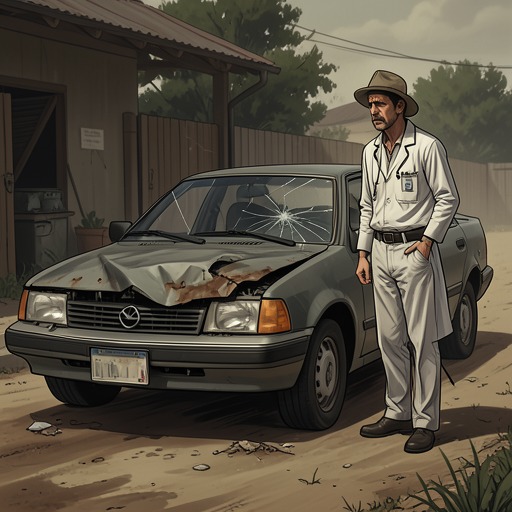
The runaway Austin crashes into the golf club pavilion
All Creatures Great and SmallThe runaway Austin crashes into the golf club pavilion when the veterinary practice’s Austin slips out of gear and races down a steep hillside with ineffective brakes. The accident turns a relaxed stop at a remote farm into a near-disaster: the car demolishes a wooden building, but appears to escape with only a smashed rear light. Its aftermath also brings into view Tristan’s fraught history of vehicle mishaps and his sense that Siegfried Farnon holds him responsible for every failing car he drives.
Setting and Circumstances
The incident occurs during the return from a Dales farm that has no road or even track leading to it. Vehicles reach the main road by crossing fields from gate to gate; by the time James Herriot and Tristan reach the last gate, the farm lies far below them. The ten-minute drive home seems close, but the Austin is parked on a steep grassy slope, where a mechanical failure will have room to gather force. James Herriot is not driving. His left hand has become infected after a difficult calving, and he has it in a sling, so Tristan is acting as chauffeur. Their visit has gone well: Tristan has removed warts from a heifer’s teats, and the farmer has praised his work and offered him two bottles of beer in the heat. The ease of the stop matters to the turn that follows. Tristan lingers rather than driving through the gate, and the quiet pause ends only when the car begins moving by itself.
The Runaway and Collision
The Austin slips out of gear and starts rolling backwards down the slope; its brakes are of little use. Tristan and James pursue it, but Tristan can only touch the bonnet before the car moves too fast to catch. As it gathers speed over the uneven hillside, its doors fly open. Bottles, instruments, bandages, cotton wool, veterinary medicines and other supplies spill out, leaving a scattered trail across the grass. The vehicle’s medical contents turn the accident into a disruption of the working practice as well as a threat to the car. There is only one obstruction on the bare hillside: a small building near the bottom, where the land levels out. The Austin bears straight towards it. James looks away at the moment of impact; when he looks back, the building has been flattened and the car lies on its side atop the broken timbers, its wheels still turning. The crash seems to promise a wrecked vehicle and a serious reckoning. Yet the scene has a strange imbalance: the wooden structure is destroyed, while the Austin’s damage is not immediately as extensive as its violent descent suggests.
Discovery and Immediate Aftermath
The building’s ownership is unclear until James and Tristan return to the farmhouse for help. The farmer, Mr. Prescott, receives them amiably and opens more beer when they report the accident. He explains that the demolished hut belongs not to him but to the golf club, which rents part of his land for a small nine-hole course. It is the club’s clubhouse, the only wooden building in the fields. His account reveals the full consequence of the collision: the car has not merely struck an outbuilding but destroyed the golf club’s headquarters. Mr. Prescott does not treat the loss as a grave matter. He says that hardly anyone plays the course, and adds that the bank manager is among the few who do and that he dislikes him. He fetches a horse, and they return to the Austin and pull it upright. Tristan starts it; the engine works, and he drives carefully over the fallen wooden walls onto the grass. On inspection, the car’s already battered body makes it difficult to distinguish fresh damage from old. Its rear end is caved in, but the conspicuous new fault is a smashed rear light. The car’s survival changes the practical stakes: despite the flattened clubhouse and the trail of equipment, they can continue their journey under their own power.
Concealment, Responsibility, and Significance
As Tristan prepares to leave, Mr. Prescott proposes that neither of them tell anyone about the incident. Tristan accepts, and the farmer’s willingness to keep quiet lets the pair depart without an immediate report to the golf club or to Siegfried Farnon. The concealment is not complete, however. On the road, Tristan recognizes that the broken rear light remains visible and that he will still have to confess that much to Siegfried. The escape therefore resolves the immediate danger without removing the prospect of blame. Tristan places the accident within a longer run of vehicle trouble. Only a fortnight earlier he had overturned the Hillman while taking a girl home from a dance; the car had been written off, and Siegfried had finally dismissed him after becoming furious. Tristan had been dismissed before and expected Siegfried eventually to relent, but the recent crash had led to an unusually serious break. Meanwhile, Siegfried had obtained a new Rover with help from his bank manager, and Tristan saw that purchase as having displaced the earlier dispute from his brother’s attention. In this scene, the Austin’s destruction of the pavilion threatens to revive the pattern just as that attention seems to have moved elsewhere. Tristan complains that he is repeatedly blamed for the condition of Siegfried’s cars, including when worn tyres lead to a puncture, and argues that he is given old wrecks to drive. James answers that Siegfried tends to lash out at whoever is nearest. Tristan’s own account complicates his defence: he concedes that he was not wholly blameless in the Hillman accident, recalling that he had taken a sharp turn at sixty. Yet he still describes himself as a victim of bad luck and prejudice. The scene leaves both explanations standing. A mechanical failure begins the Austin’s descent, but Tristan’s history makes the broken rear light more than a minor repair: it is another possible entry in the case against him, and another occasion for him to contest how responsibility is assigned.